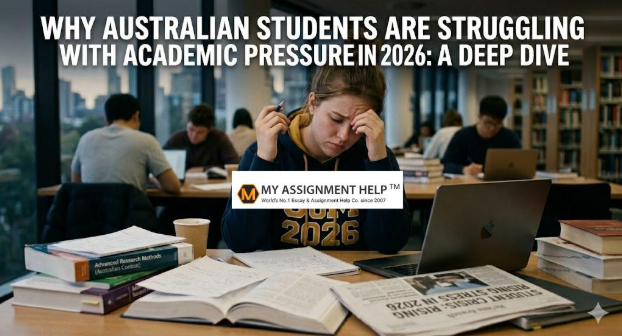

The landscape of Australian education has undergone a seismic shift over the last few years. As we move through the second quarter of 2026, the familiar “stiff upper lip” approach to schooling has been replaced by a complex, high-pressure environment that is pushing high school and university students to their limits.
From the bustling inner-city suburbs of Sydney and Melbourne to the regional classrooms of Queensland and Western Australia, a common thread emerges: students are overwhelmed. But why now? Why, in an era of advanced educational technology and increased mental health awareness, is academic pressure at an all-time high?
In this comprehensive analysis, we explore the unique factors driving this crisis—from “Complexity Inflation” to the “ATAR Obsession”—and offer insights into how the Australian education system can find a sustainable path forward.
1. The “Digital Fatigue” of 2026: Beyond the Screen
By 2026, the integration of AI and hyper-digital learning environments is no longer a novelty; it is the baseline. While these tools were marketed as a way to simplify research and democratise information, they have inadvertently increased the volume of work expected from the average student.
Australian high school students, particularly those tackling the HSC (NSW), VCE (VIC), or QCE (QLD), are no longer just competing with their peers in the classroom; they are competing with the perceived efficiency of generative algorithms. The “always-on” nature of digital portals—Canvas, Blackboard, and proprietary school apps—means that the physical boundary between home and school has effectively vanished.
When students are expected to engage with learning modules 24/7, the brain never enters a state of true “rest.” This leads to a phenomenon known as cognitive overload, where the quality of deep learning drops as the quantity of administrative tasks increases. Myassignmenthelp has observed that the expectation for “instant” drafts and 24-hour turnaround times on feedback has created a treadmill effect that few can sustain without significant mental health repercussions.
2. The ATAR Obsession and University Entrance Anxiety
Despite years of debate regarding the relevance of the Australian Tertiary Admission Rank (ATAR), its grip on the psyche of Year 12 students remains ironclad in 2026. If anything, the stakes have shifted. While some vocational pathways have opened up, the competition for “Group of Eight” (Go8) universities has intensified to a fever pitch.
As international education markets fluctuate and local funding models evolve, Australian universities have become more selective with domestic placements in high-demand fields like Medicine, Engineering, Quantum Computing, and AI Ethics. For a student in Perth or those seeking specialized assignment help Adelaide , falling short of a predicted rank by even a fraction can feel like a life-altering failure.
This “rank culture” fosters an environment of perfectionism. Students are no longer aiming for “good” grades; they are aiming for “statistically superior” positions. This environment is a primary driver of clinical anxiety among Australian teenagers, who view their worth through the lens of a two-digit decimal point.
3. The Cost-of-Living Crisis Hits the Classroom
We cannot discuss academic pressure without addressing the economic reality of 2026. Australia’s cost-of-living remains a significant hurdle for the “Gen Alpha” and “Gen Z” demographics currently in the system. For university students, the pressure to maintain a high GPA is compounded by the need to work 25–30 hours a week just to afford basic rent in cities like Brisbane, Sydney, or Melbourne.
The “Working Student” of 2026 is an exhausted one. When a student is balancing a rigorous Bachelor of Laws or Nursing degree with a service-sector job, sleep is often the first sacrifice. This creates a vicious cycle: exhaustion leads to poor academic performance, which leads to increased stress and the fear of losing HECS-HELP eligibility, which further degrades mental health.
4. The Rise of “Complexity Inflation”
The curriculum in 2026 is objectively more difficult than it was a decade ago. With the rapid advancement of technology and science, the baseline of knowledge required for high school graduation has risen. This is what educators are calling “Complexity Inflation.”
Students are now expected to master complex data analysis, Python coding, and critical thinking skills that were previously reserved for second-year university courses. In 2026, a Year 11 standard English or Maths assignment requires a level of multi-modal synthesis that would have baffled previous generations.
This inflation means students are spending more time on a single assignment than ever before. Many find that they simply cannot keep up with the syllabus pace without external support. In such high-stakes scenarios, seeking professional academic support for Australian students becomes a vital lifeline for those struggling to bridge the gap between classroom teaching and the sophisticated requirements of 2026 assessments.
5. The Mental Health Paradox
Australia has some of the best mental health initiatives in the world, yet a strange paradox has emerged. While students are more “literate” in mental health terminology, the actual stigma surrounding “academic failure” persists.
The pressure to be “well-rounded” is the new burden. Students feel they must excel in sports, lead extracurricular clubs, maintain a polished social media presence, and achieve top grades simultaneously. The psychological toll of trying to “have it all” in a hyper-competitive economy cannot be understated.
6. Navigating the 2026 Academic Calendar: Key Milestones
As we move into the second half of the year, the pressure points in the Australian calendar become more defined:
- May/June (Mid-Year Exams & GAT): For Victorian students, the General Achievement Test (GAT) is a major stressor. Mid-year assessments across the country serve as the first “reality check” for Year 12s.
- July/August (Trial Exams): This is statistically the month where burnout peaks. The “Trials” in NSW and similar mock exams in other states carry immense weight and often dictate early entry offers.
- October/November (Final Exams): The culmination of 13 years of schooling. The intense focus on these few weeks creates a “pressure cooker” environment.
7. Strategies for Survival and Success
If you are a student feeling the weight of these expectations, remember that strategic management is better than raw “hustle.”
Prioritise Deep Work over “Performative Study”
Focus on two hours of intense, distraction-free study rather than six hours of scrolling through notes with a screen in the background. Use the Pomodoro Technique to protect your cognitive energy.
Seek Collaborative Support
Don’t suffer in silence. Use tutoring services, school study groups, and reputable academic resources. If a specific subject—like Advanced Mathematics or Data Science—is dragging your GPA down, getting specialised assistance for Australian assignments can provide the clarity needed to move forward.
Frequently Asked Questions
Q.1 How has the ATAR system changed in 2026?
While the ATAR remains the primary tool for university entrance, many Australian institutions have introduced more diverse “Early Entry” pathways and “Portfolio-based” admissions. However, for high-demand courses in the Go8 (Group of Eight), the ATAR requirements remain extremely high, often necessitating a rank of 95.00 or above, which continues to drive significant student stress.
Q.2 What is “Complexity Inflation” in the 2026 curriculum?
Complexity Inflation refers to the increasing technical difficulty of high school subjects. Due to the rapid evolution of AI and data science, Year 11 and 12 students are now expected to perform tasks—such as advanced coding or complex socio-economic modelling—that were previously university-level content. This has led many to seek expert academic guidance to keep pace with the syllabus.
Q.3 Does working a part-time job affect academic performance in Australia?
Data from 2026 suggests that students working more than 20 hours per week are at a higher risk of academic burnout. The rising cost of living in cities like Sydney and Melbourne has forced many university students to balance heavy workloads with full-time study, frequently leading to sleep deprivation and decreased GPA performance.
Q.4 How can I apply for Special Consideration for my exams?
If you are experiencing clinical anxiety or significant personal hardship, you can apply through your state board (NESA, VCAA, etc.) or university portal. You will typically require medical documentation. These “equity pathways” are essential for ensuring that students’ grades reflect their true potential despite external pressures.
Conclusion: A Call for Balance
The academic pressure facing Australian students in 2026 is a multifaceted issue. While the drive to succeed is admirable, it should never come at the cost of a student’s well-being. Whether you are a Year 12 student in Melbourne or a PhD candidate in Canberra, remember that your value is not defined by your ATAR or your GPA.
About the Author – Drake Miller
I am a passionate blog author associated with Myassignmenthelp.services, dedicated to creating insightful and student-focused content. I specialize in topics related to academic writing, study strategies and assignment help. My goal is to simplify complex concepts, share practical tips and help students achieve better academic outcomes through reliable guidance and well-researched information.